
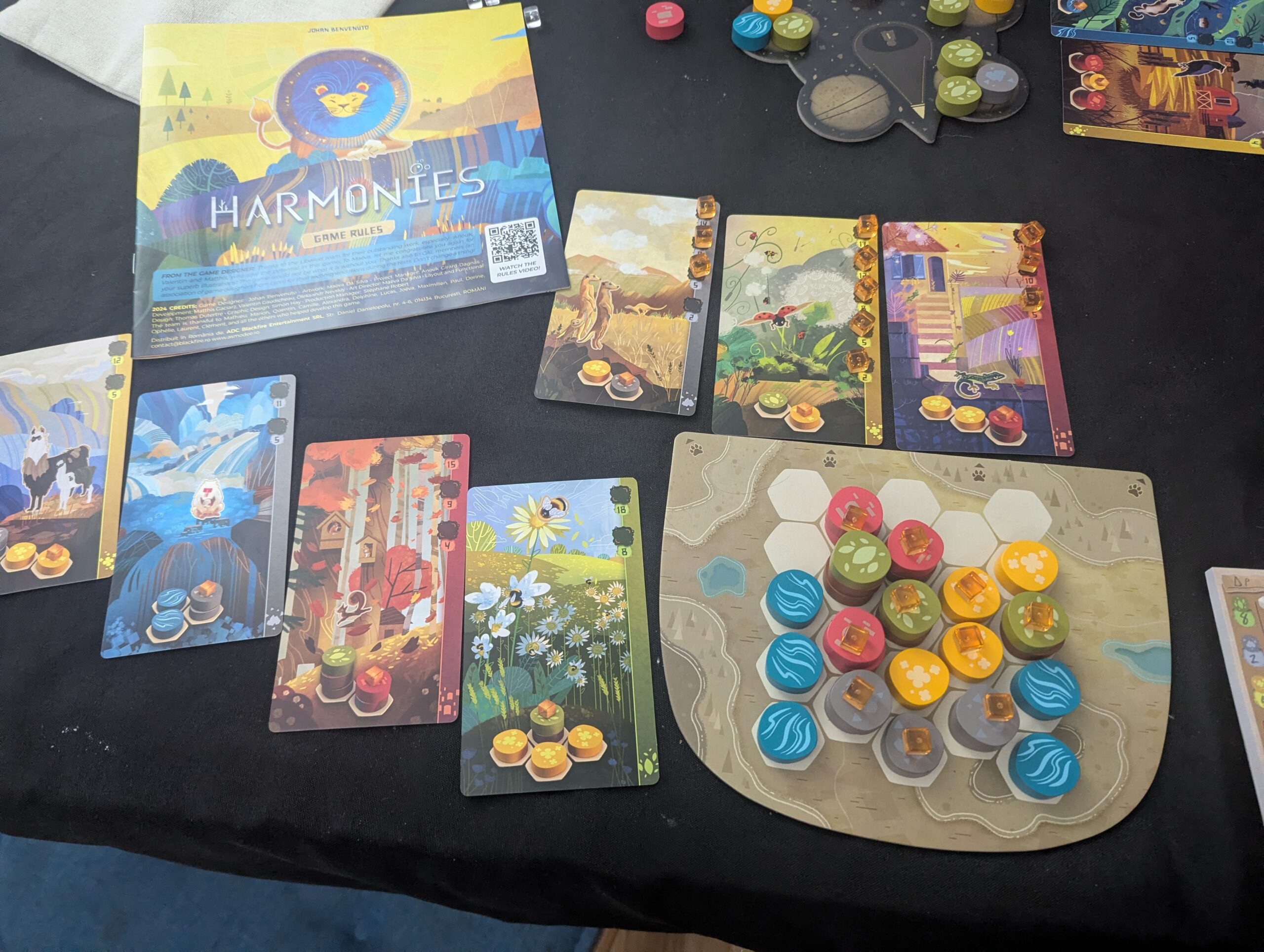
Every Christmas my in-laws request a list of presents I might like which at first was a very alien experience for me as my family’s gift giving technique involved guess work and surprise which is how I wound up with SAT prep software one Christmas and my brother got a pair of curved glass-handled daggers for another. That being said, occasionally my list isn’t robust enough to match my in-laws’ generosity and they have to parse their knowledge of me to come up with something surprising and delightful. This is how the above copy of Harmonies entered my gaming library this year.
Last year I wrote up about the gentle animal and tile placing game Cascadia and on the surface Harmonies seems to be made of similar stock. Every turn you are presented with terrain tiles you need to situate on your player map and then you can try to populate them with different wildlife like bees and ocelots. While Cascadia is a game of fairly relaxing building out and up, Harmonies presents a more intense experience.
For one thing, the space you’re working with feels much more limited. Your map has two sides that offer slightly different game modes but both are going to constrain what directions you can build out in. Where you can try to maximize space is by building up as well as out. While rivers and fields are limited to one tile in height, trees, mountains, and buildings let you stack two or three high so your spatial reasoning is going to be given a workout.
Secondly you can’t just pop any old animal in any old spot. Animals in this game are very specific about where they want to live. Bees want to live in a tree surrounded by no less than three fields. Llamas want to live in a field next to a field which is itself next to a mountain. Every turn you can go shopping in the animal market and it feels almost like a stock market game. Just how valuable are the beavers going to be to me in the future? Am I really going to have enough trees to make this worth my while or should I double down on squirrels? Animal populations are tracked by cubes that start out on the animal card and as you open up habitats for them, they move onto your player map. The more you plonk down, the more points you get at the end of the game. However, once you’ve populated a mountain or a tree, that’s as high as it can get and no other animal can call it home so plop wisely.
At the end of the game points are awarded both for the number of animals you’ve found homes for and also for how you’ve laid out the terrain. This is a tricky bit of business that can make the rest of the game feel a lot tighter. Rivers just want to be long and windy and trees want to grow high which is simple enough. Mountains also want to be tall but they only score if they’re next to other mountains. Buildings want a variety of terrain touching them or they’ll withhold all their points. Fields want to be set down in groups of three and that’s it. On the alternate player map side, instead of rivers you’re building islands which have their own scoring needs. Keeping all these different rubrics in your head while also trying to shove bears and lizards onto logs and rocks gives this game a lot more edge than its happy pictures and colorful tiles might suggest.
If however, all that seems too simple for you, they have an advanced mode where you also have these super animals you’ve got to find spaces for so go nuts!
This game is fast and intense so suited well for an early night game to get the blood pumping rather than an end of the night cooldown game. Fun and full of replayability. Get stuffing those squirrels!