
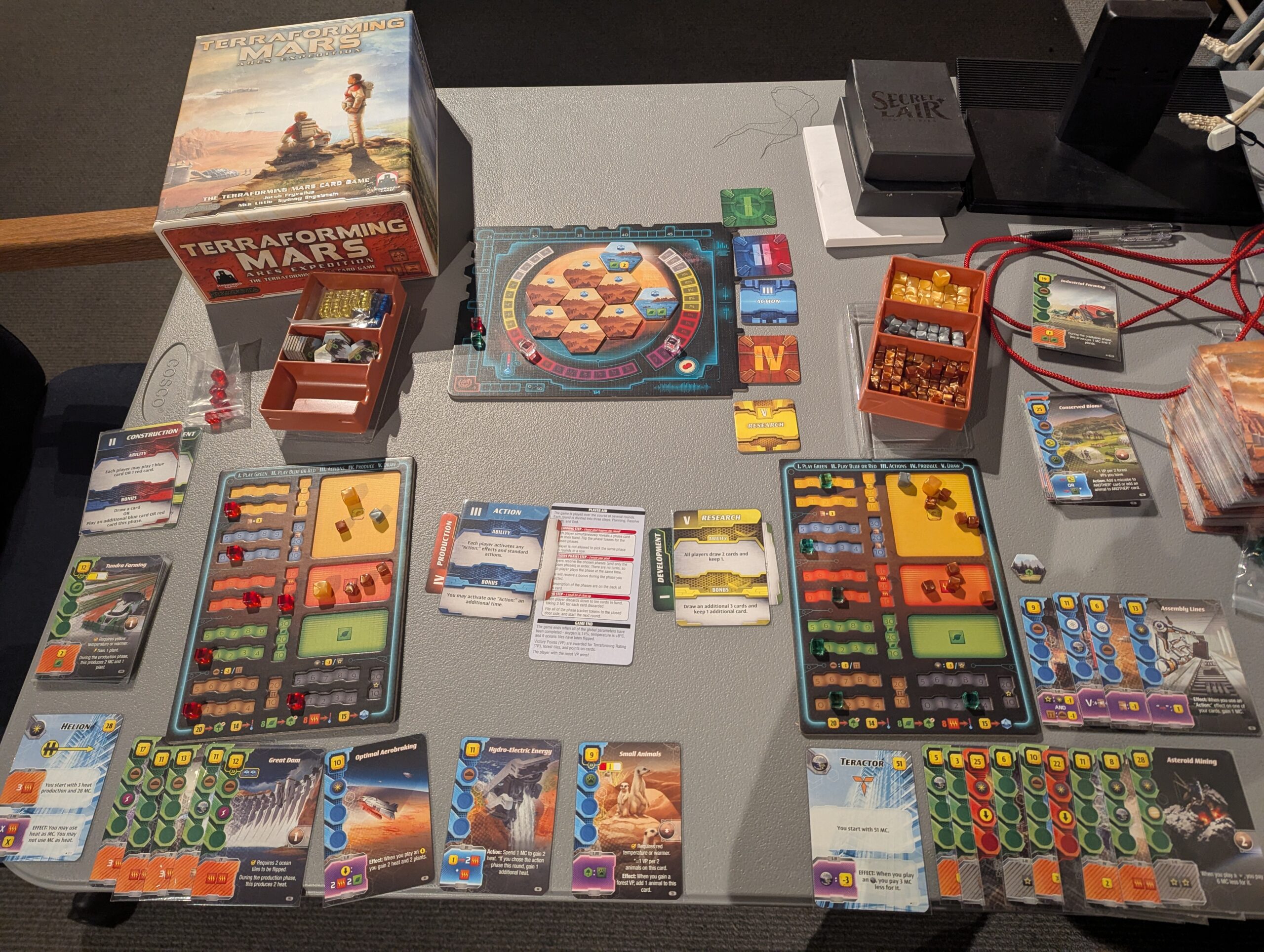
Longtime followers of this blog and my online ramblings will know that I am a hardcore (if occasionally conflicted) fan of the Terraforming Mars board game and its many many expansions. When I learned that they had put out a streamlined version, I was interested but also felt like I couldn’t justify paying for a brand new version of the game that couldn’t make use of the Too Many Expansions I had invested in. (quick sidenote, if you’re only going to get one thing to improve the game, get these custom player boards) Luckily, my friendly local game store had a copy for patrons to peruse so I popped it out and did just that so I could bring my findings to you all.
The goal of both Terraforming Mars games is to make the red planet wetter, hotter, and greener through spending money on terraforming projects and also playing various cards that either offer one time rewards or long-term effects. Players play as different corporations with unique bonuses. After that, the games’ similarities diverge. Original Terraforming Mars is a big chunky engine builder where players take long turns going back and forth prioritizing which cards to play or which actions to take. There’s a lot of choice although you are often constrained by what cards come your way.
Ares Expedition is a much more streamlined game that borrows a concept from Race For the Galaxy that allows for very quick turns. At the start of a round, players take turns secretly picking one or two of five different actions. They reveal their actions and then those are the only actions available to all the players for the whole round with the player picking it getting a little bonus. These actions include drawing new cards, gaining resources, taking actions, and playing specific kinds of cards. Players take these actions at the same time so rounds go by sharp and quick.
Instead of the big map of Mars dominating the table with all its strategic choices about where to plop down cities or crack open aquifers, Ares Expedition gives a much smaller and more abstract board simply to indicate how wet, hot, and green things are getting. This makes for much less table presence and allows players to focus more on their hands and the cards in front of them. The art on the cards is also less chaotic and more standardized across the whole game.
Of the two games, I still prefer the original but if I was at a game night with acquaintances or strangers I’d feel more comfortable suggesting Ares Expedition as a quicker, faster, more compact game that we could finish in a quarter of the time. I’m glad I got my chance to poke and prod but I feel justified staying with my unnecessarily large boxes.
Coming soon will be my thoughts on their upcoming RPG…