
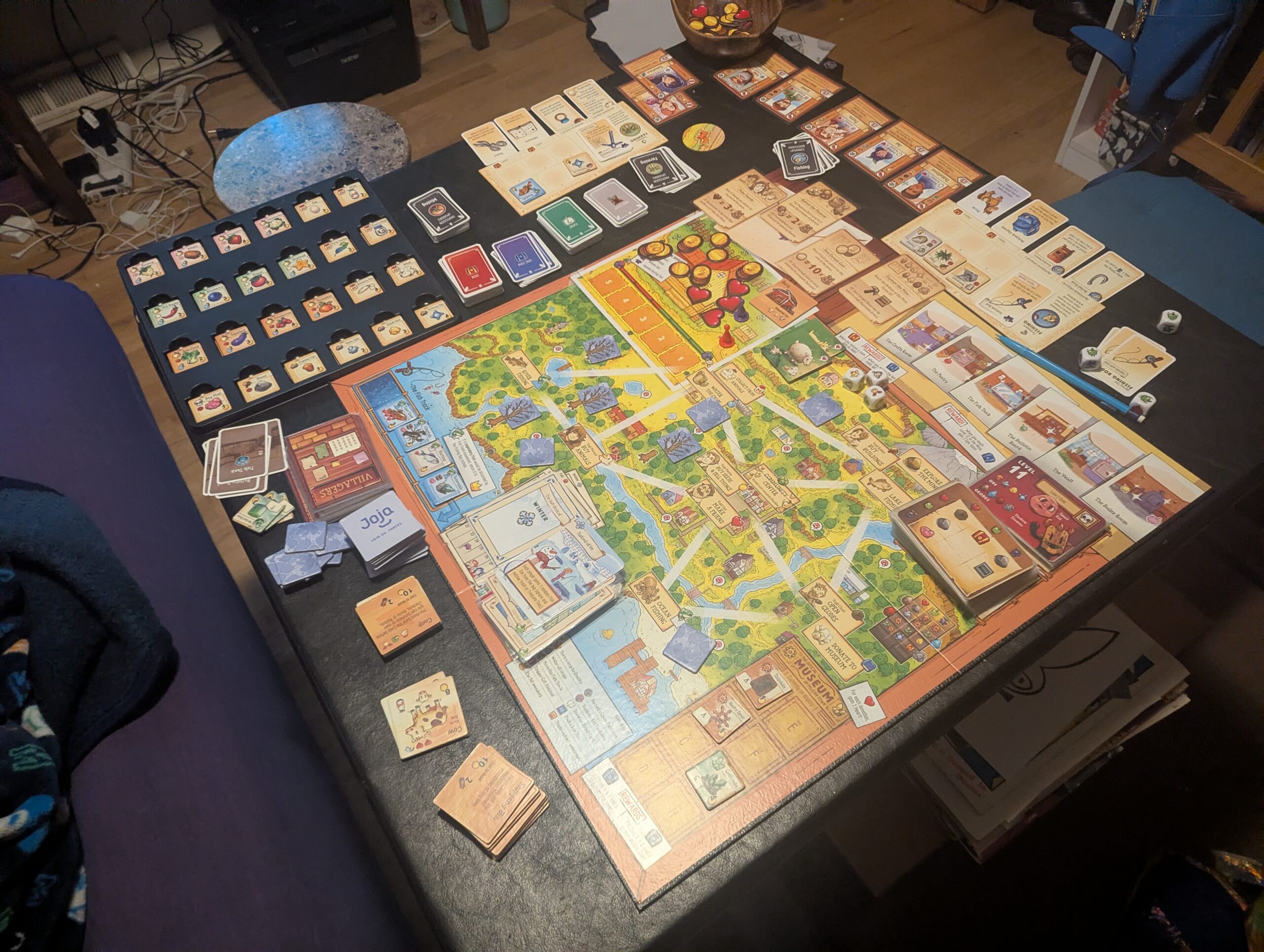
Stardew Valley has long been a warm cozy videogaming experience for me and so it was gratifying when both of my kids took to the game even if it does lead to occasional Camp David-esque negotations about whose turn it is with the iPad. Thus I was delighted and/or confused to find there was a board game adapatation and wondered if perhaps this might be a way for us all to collectively experience the game on less fraught terms. The reality is we changed one set of stressors for another although not in altogether unpleasant ways.
It’s a solo or cooperative game where you have one calendar year made up of 16 days/rounds in which to accomplish anywhere from 4 to 11 goals depending on the difficulty setting you choose. The easiest victory just involves accomplishing 4 tasks set by your grandfather. At medium difficulty you also need to unlock and fulfill all 6 community center bundles. The hardest challenge involves ending the game with all these goals accomplished while also getting rid of any JoJa Mart penalties.These goals largely revolve around collecting the various pastoral or mineral resources, accumulating wealth or friendship, improving yourself or your farm, and delving. All these activities are familiar to longtime Stardew Valley players with a key difference of the time limit looming over your every move. A year can go by very quickly, particularly when you waste it gambling on the wrong fish or bashing your head against bats in a cave.
At the start of the game, players choose a profession – Farmer, Miner, Forager, or Fisher and then takea starting tool – Hoe, Fishing Pole, Pickaxe, or Watering Can. These provide bonuses for various taks throughout the game. Players can mix and match or double down. After that the most crucial decision is whether to make the Starting Player piece a kitty cat or a puppy dog.
The year is divided into 4 seasons of 4 days each represented by a card. At the start of every round/day players draw a card and either have a festival with its own special rules or trigger a series of good and bad events such as crop advancing rain, crop devouring crows, adding new fish, JoJa Mart messing everything up, or being able to sell off goods for much needed cash. After resolving the card, players can then plan their day by swapping items and resources and then moving their piece to one of the many different areas on the map depending on what they want to do. They are limited to two actions with the option to move once to a new area so planning is vital. All the various actions are interlinked and so timing is crucial. You can’t water crops until you buy seeds or collect milk and wool unless you buy animals or donate to the museum until you’ve delved in the cave. Moving from space to space also allows players to harvest seasonal foraging resources which is one of the few ways to get wood which is needed for buying new buildings which is the only way to get animals and so on and so on.
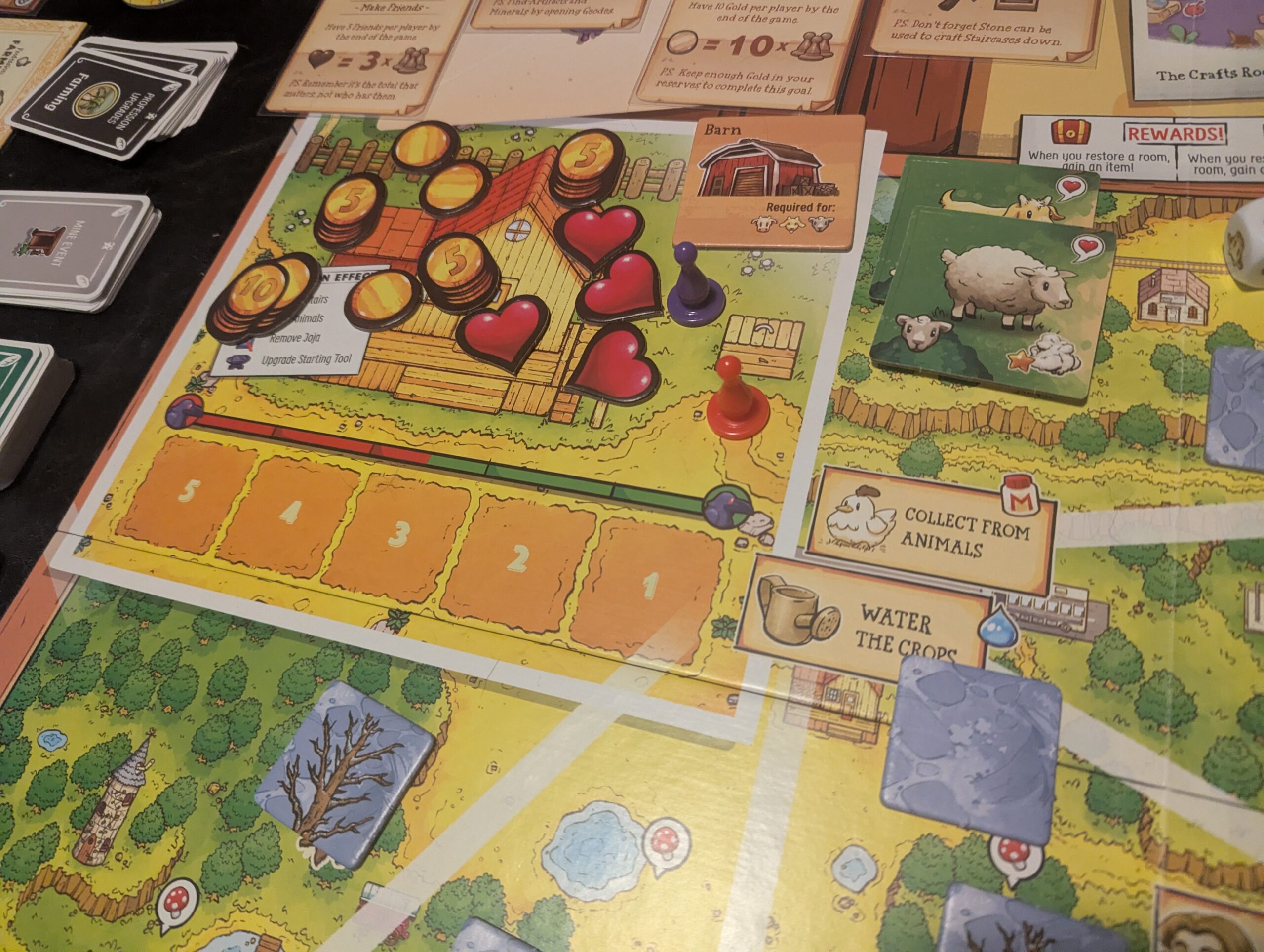
Some of these actions are vital for achieving the winning conditions of the game, others are just useful ways to collect the resources to help you along the way. Figuring out the efficient ways to take these actions and in what order is crucial. If you keep bopping to the museum to drop off artifacts one at a time you’ll quickly run out of time but if you try to hoard up a bunch of items to do one big mega-dump you’ll run out of inventory space and wind up discarding stuff you might need. Some of the actions bring their own mini-game such as fishing, delving, or harvesting from animals. A lot of the actions are pure randomness. Take making friends: it’s one of the few ways to get hearts which are needed for knowing what community center bundles you need to be working on but each time you take the action you randomly draw from a deck, not knowing if your pocketful of gift fish will be acceptable or reviled by the recipient. Mining and fishing also involve both rolling dice and reaching into bags and praying to pull out something useful. If you’ve had the misfortune of drawing JoJa cards, your tasks will be all the harder to accomplish
After taking their two actions, players return to the farm and can then take special end of the day actions such as trading rocks to build staircases to move more quickly through the mines. discarding hearts to pet animals to make them squirt out quality goods, bribing JoJa to go away, or upgrading tools. Once everyone has done what they can, a new card is drawn and a new day’s work begins. Between seasons, forageables are swapped out and players get to draw profession upgrade cards to make their tasks a little easier. If final day of winter passes the game ends and players check to see if they have accomplished all they set out for.
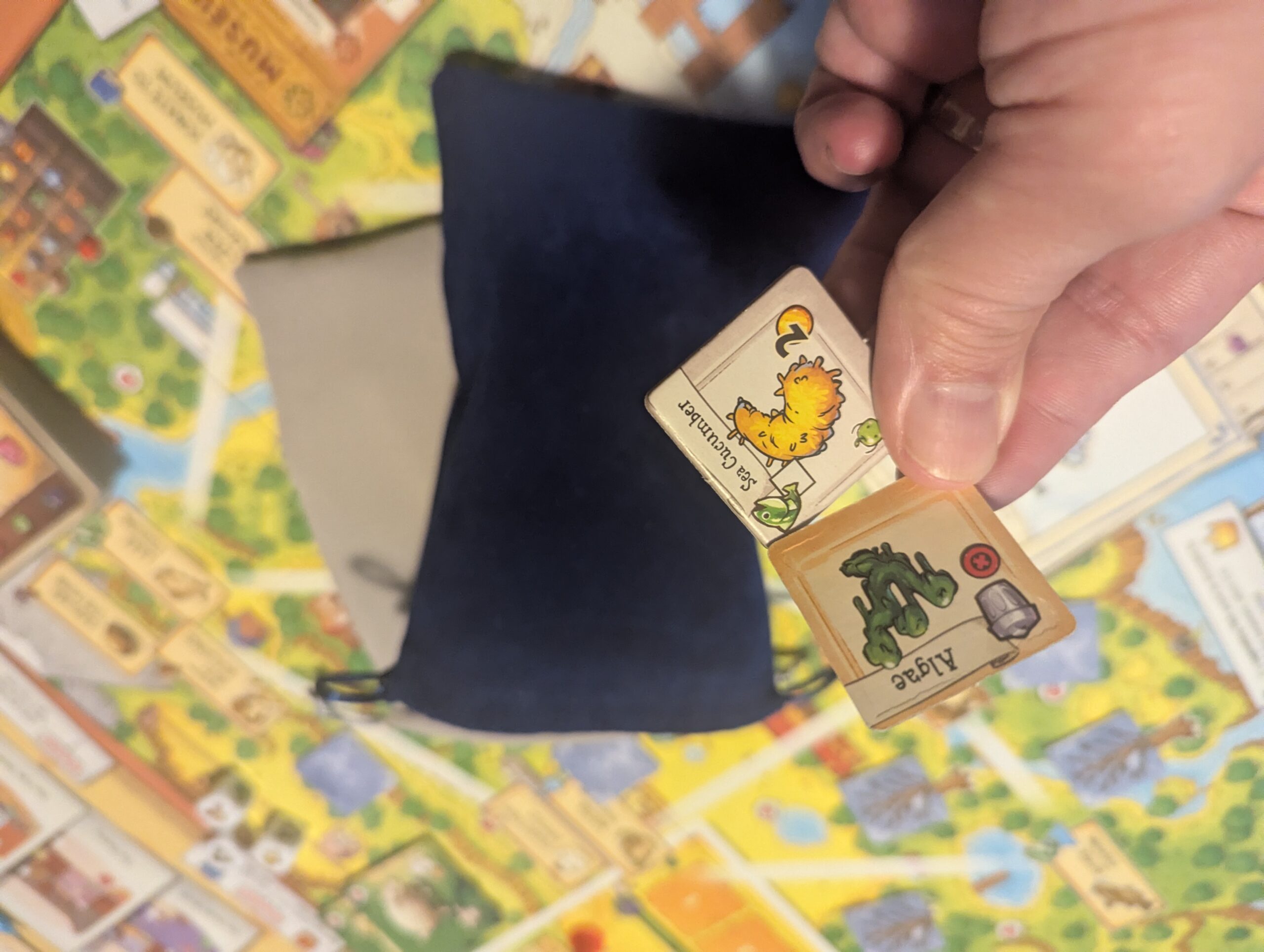
As cooperative games go, this is a pretty intense one. The cuteness to harshness factor goes pretty hard and given how random things are, setbacks can feel arbitrary and frustrating. The game provides some abilities to change out some of the goals and bundles but you can still wind up in situations where you don’t know that you need to collect spring produce for the community center bundle until after that bundle has been revealed and spring is passed. I keep feeling like I need just one or two more days to accomplish everything which possibly speaks to how tightly they’ve made the game but often things just feel more frustrating than fun and planning feels more like paranoia than cleverness. Still it’s an interesting way to experience the familiar Stardew Valley setting and themes and when you do just narrowly accomplish things it can feel quite satisfying.